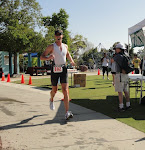
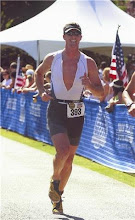
And there I was again, on the starting line of yet another race. This time it was only a ride, 56 miles to be exact. It was a beautiful morning in Mountain View, 65 F and sunny. However, the ride was not in Mountain View but in San Mateo: fog , wind and 54 F. Check-in went well, and on our way we rolled. Once we got out of San Mateo, the sun came out and the views were great. Grateful to be in my first race since June last year, I took in the great competitive atmosphere and the scenic route. As we got to the top of one of many climbs and started our decent, I saw something out of the corner of my eye. As I turned my head and saw a deer coming full throttle down the mountain side I thought: is this how peolple will remember me, the guy who got taken out by a deer? There was nothing I could do but to anticipate the impact. Seconds later the deer's head hit my hip and he spun like a tumbleweed in the wind, and I .... nothing! I kept going like nothing had happend. The only evidence that I was hit was the non-functioning speedometer. Who would have thought that getting hit by a deer on my bike would be my first animal encounter while on a vehicle?
The race went on and I finished in 3 hours and 23 minutes. In retrospect I feel really lucky that I'm in one piece after my, hopefully, one and only deer encounter.
Sunday, June 27, 2010

Tuesday, June 22, 2010
How low is your Resting Heart Rate?
Here is a fun way of comparing power for endurance athletes, posted by Grant Lerdahl:
Ok, If you aren’t some sort of endurance junkie then you might not appreciate the significance of a low resting heart rate. Resting heart rate can be as exciting to endurance athletes as the bench press max and the 40 yard dash times are to pro football players. Its really exciting to see if you have a lower than normal resting heart rate because that means each time your heart beats it pumps more blood than an “untrained heart” would. According to Wikipedia the average RHR for health adults is between 60-80 BPM (beats per minute).
To illustrate how important this stuff is to us read the following story. One of my closest friends had his checked at the doctors office and it was 45. Since it was so low he made the doctor print it off on an official looking form and sign it. He has it framed at home right now. This makes perfect sense to me and I think its a great idea too. Of course this might sound silly but 45 BPM is wicked good especially for a 45ish year old man. If you check the fitness equivalency chart that is like bench pressing 375-400lbs (don’t look that it up its a made up chart but sounds cool).
I checked my RHR last night and it came out at 37 and 38 a couple times. I got pretty excited about my new/wicked low resting heart rate. I decided to check it for two minutes straight and it came out to be 77 or 38.5 per minute. I’m pretty pumped about it.
In order to spoil my little parade I decided to check Wikepedia for what the lowest RHR’s were. Turns out some guy no one has ever heard of, Lance Armstrong, has or had a RHR of 32. I should have just stopped there but two other great Tour De France winners Miguel Idurain and Alberto Contador have reported RHR’s of 28. Well I don’t feel as much like the man as I did 8 hours ago but I’m still pretty excited my new local bragging rights. Isn’t that what sports is all about anyways?
Ok, If you aren’t some sort of endurance junkie then you might not appreciate the significance of a low resting heart rate. Resting heart rate can be as exciting to endurance athletes as the bench press max and the 40 yard dash times are to pro football players. Its really exciting to see if you have a lower than normal resting heart rate because that means each time your heart beats it pumps more blood than an “untrained heart” would. According to Wikipedia the average RHR for health adults is between 60-80 BPM (beats per minute).
To illustrate how important this stuff is to us read the following story. One of my closest friends had his checked at the doctors office and it was 45. Since it was so low he made the doctor print it off on an official looking form and sign it. He has it framed at home right now. This makes perfect sense to me and I think its a great idea too. Of course this might sound silly but 45 BPM is wicked good especially for a 45ish year old man. If you check the fitness equivalency chart that is like bench pressing 375-400lbs (don’t look that it up its a made up chart but sounds cool).
I checked my RHR last night and it came out at 37 and 38 a couple times. I got pretty excited about my new/wicked low resting heart rate. I decided to check it for two minutes straight and it came out to be 77 or 38.5 per minute. I’m pretty pumped about it.
In order to spoil my little parade I decided to check Wikepedia for what the lowest RHR’s were. Turns out some guy no one has ever heard of, Lance Armstrong, has or had a RHR of 32. I should have just stopped there but two other great Tour De France winners Miguel Idurain and Alberto Contador have reported RHR’s of 28. Well I don’t feel as much like the man as I did 8 hours ago but I’m still pretty excited my new local bragging rights. Isn’t that what sports is all about anyways?
Friday, June 18, 2010
Monday, June 14, 2010
Got Brick?
With only one month left till my Triathlon on july 18th, the training has intensified to a new level. From previous experience, I know how hard the transition from bike to run can be. Therefore, I have decided to do more "brick" workouts. A brick workout is when you do more than one dicipline at a time. Ex: bike and run, or swim and bike. Today I did my first real brick workout, 17 miles of biking (55 min.), and 3.1 miles of running (24.21 min.). It felt pretty good even though I sweated like a hog. It was a very hot day and I know that I didn't drink enough, but the good thing was that I didn't cramp. This time around, I am not going to lack electrolytes. In the past I have had a problem with cramps, but now I have ordered electrolytes in pill form and powder for drinks.
This week I have a light work load and I plan to take full advantage of it. I will do lots of riding to prepare for my 100km ride on June 26th. All the articles I have read say that getting stronger on the bike will help you run better in the triathlon. I'll let you know if it works (gulp - fingers crossed)!
This week I have a light work load and I plan to take full advantage of it. I will do lots of riding to prepare for my 100km ride on June 26th. All the articles I have read say that getting stronger on the bike will help you run better in the triathlon. I'll let you know if it works (gulp - fingers crossed)!
Wednesday, June 9, 2010
Stretching, foam roller or stick?
Stretching has been one of the biggest questions, before, after or both? Should I use a foam roller or stick? For many years everyone said that we should stretch (static stretch) before and after every workout. However, in the last few years, all I have read says: "dynamic streching before, and static streching after". There are so many benefits to stretching: better flexibility, circulation, posture, injury prevention.........
For us who can't afford to get a massage every week, a foam roller, or a stick, is a good alternative. The foam roller is great for the hard to stretch areas such as the IT band (along the outside of your upper leg area), but can also be used for many other areas. It works as a deep tissue massage, and having said that, be careful with the amount of pressure you put on it. If you put too much pressure, you might get bruised. Any time you feel pain, the muscle fights back by tensing up. If the muscle tenses up for too long, you might get sore just like how you get sore from a workout. I have used the the foam roller and the stick for years, and they really work. I use them to complement my regular stretching when needed. Here is a link to a good article: http://www.performbetter.com/catalog/matriarch/OnePiecePage.asp_Q_PageID_E_225_A_PageName_E_Boylefoamrollers.
Stretching is important, and foam rollers and sticks are great tools to make it easier for some hard to stretch areas. You can find them at most yoga stores and sporting goods stores.
For us who can't afford to get a massage every week, a foam roller, or a stick, is a good alternative. The foam roller is great for the hard to stretch areas such as the IT band (along the outside of your upper leg area), but can also be used for many other areas. It works as a deep tissue massage, and having said that, be careful with the amount of pressure you put on it. If you put too much pressure, you might get bruised. Any time you feel pain, the muscle fights back by tensing up. If the muscle tenses up for too long, you might get sore just like how you get sore from a workout. I have used the the foam roller and the stick for years, and they really work. I use them to complement my regular stretching when needed. Here is a link to a good article: http://www.performbetter.com/catalog/matriarch/OnePiecePage.asp_Q_PageID_E_225_A_PageName_E_Boylefoamrollers.
Stretching is important, and foam rollers and sticks are great tools to make it easier for some hard to stretch areas. You can find them at most yoga stores and sporting goods stores.
Sunday, June 6, 2010
Let your body talk!
Another week is at an end, and the weather has been at its best. This week, I got some good workouts in and I'm feeling better and better. 16 miles of running and 68 miles of riding. The body is still holding up, but there is a lot left to be done.
I have had so many people ask me to blog injury problems and prevention. My answer is: "don't hurt yourself", just kidding. I have found that working with people who have all sorts of ailments keep me on my toes. I have always been interested in how the body works, and how to fix it. Through my many years of being an athlete, I was blessed with a great foundation and a coach that didn't push me beyond my limits. I did have my share of injuries, but nothing that was serious enough to keep me side lined for long. Through my experiences, and my curiosity, I have found great satisfaction in finding ways of working around troubled areas.
We don't always do the smartest things, and I'm a big example of that. However, if we listened to everything we should stay away from we'd be left sitting in front of the tv twiddling our thumbs. For us who actually like to enjoy life, that is not an option. Having said that, we still have to build our bodies appropriately. From my own experience, I can tell you that there are times when my head still thinks that I am 22 and at the peak of being a world-class decathlete. It's great to stay young, "perform young" but do know your body's limits!
It's easy to find the problems, but what is more important is to find the solutions. I have found it more effective to tighten/strengthen than to strech. If you have a small tear, please don't make it worse by trying to strech it. Or, for all you people with back problem, don't strech an already weak back, strengthen it instead.
Keep following my blog to get some tips on how to strech and strengthen for injury prevention.
I have had so many people ask me to blog injury problems and prevention. My answer is: "don't hurt yourself", just kidding. I have found that working with people who have all sorts of ailments keep me on my toes. I have always been interested in how the body works, and how to fix it. Through my many years of being an athlete, I was blessed with a great foundation and a coach that didn't push me beyond my limits. I did have my share of injuries, but nothing that was serious enough to keep me side lined for long. Through my experiences, and my curiosity, I have found great satisfaction in finding ways of working around troubled areas.
We don't always do the smartest things, and I'm a big example of that. However, if we listened to everything we should stay away from we'd be left sitting in front of the tv twiddling our thumbs. For us who actually like to enjoy life, that is not an option. Having said that, we still have to build our bodies appropriately. From my own experience, I can tell you that there are times when my head still thinks that I am 22 and at the peak of being a world-class decathlete. It's great to stay young, "perform young" but do know your body's limits!
It's easy to find the problems, but what is more important is to find the solutions. I have found it more effective to tighten/strengthen than to strech. If you have a small tear, please don't make it worse by trying to strech it. Or, for all you people with back problem, don't strech an already weak back, strengthen it instead.
Keep following my blog to get some tips on how to strech and strengthen for injury prevention.
Subscribe to:
Posts (Atom)